“Are we starting too early?” “Have we already missed the window?” These are two versions of the same question I hear constantly from parents considering French immersion. The honest answer is that timing matters, but maybe not in the way you’d expect.
There isn’t a single perfect age to start. But there is a window where language learning happens most naturally, and understanding it can take a lot of pressure off the decision. We covered the neuroscience behind bilingual brain development in a previous article. Here, we’ll get specific about timing.
There’s no age that’s too late to start. There’s simply an age where it stops requiring effort and starts happening on its own.
Why Age Matters: The Critical Period for Language Acquisition
Linguists refer to early childhood as a “critical period” for language acquisition, a stretch of years when the brain is uniquely wired to absorb language through exposure alone, without formal teaching. This window doesn’t slam shut on a birthday. It narrows gradually, generally from around age seven onward.
During this period, children don’t need grammar rules explained to them. They absorb sentence structure, pronunciation, and rhythm the same way they absorbed their first language: through repeated, meaningful exposure. This is very different from how older children and adults typically learn a second language, which usually involves conscious study and translation.
Research on infant speech perception, including work by Patricia Kuhl, has shown that very young children can distinguish sounds from any language on Earth, an ability that narrows as they specialize in the languages they hear regularly. This is part of why starting early tends to produce more natural pronunciation and rhythm than starting later.
💡 Did You Know?
Children who begin a second language before age five typically develop native-like pronunciation, while those who start after age twelve usually retain some accent, no matter how fluent they become.
What Immersion Looks Like at Each Age
Immersion doesn’t look the same at 18 months as it does at 5 years old, and it shouldn’t. Here’s a general breakdown of what to expect.
| Age Range | What Immersion Looks Like | Key Advantage |
|---|---|---|
| 16 months – 2.5 years | Sounds, songs, and simple words absorbed alongside first-language development | Zero effort required — dual language pathways form simultaneously |
| 2.5 – 4 years | Active vocabulary building through play, routines, and repetition | Fastest window for natural accent and fluency |
| 4 – 6 years | Full sentences, storytelling, early reading readiness in both languages | Strong foundation before elementary school |
| 7+ years | More structured, classroom-style instruction typically needed | Still highly effective, but requires more active effort |
The Case for Starting as a Toddler
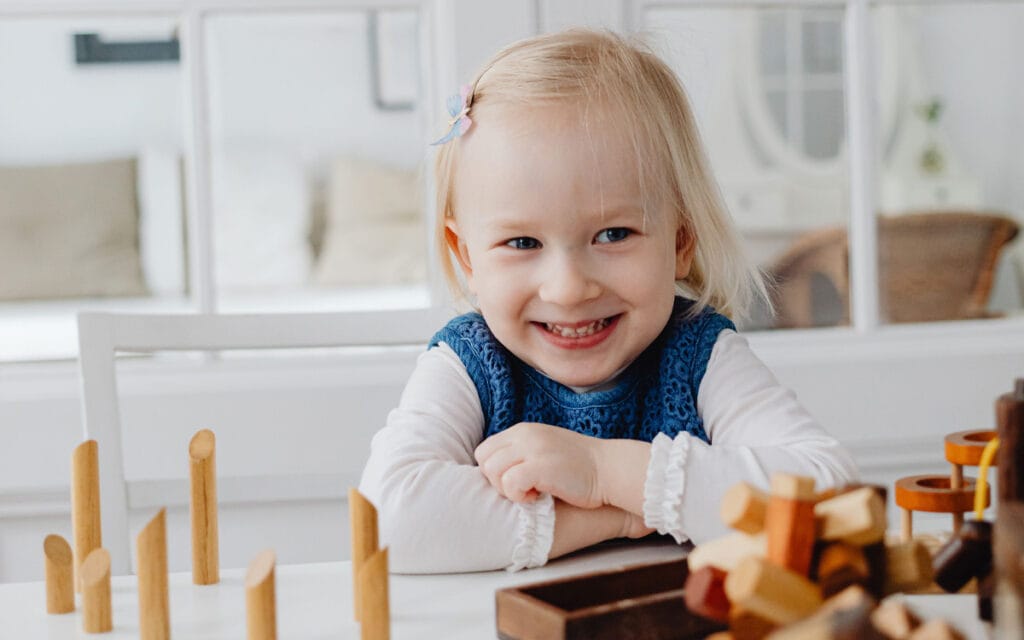
Starting immersion as a toddler, roughly 16 months to 3 years, means a child’s brain is building both languages at the same time, from the same starting point. There’s no “first” language to translate from. Both simply become part of how the child understands and describes the world.
In the Classroom
Toddlers don’t study a language. They live in it.
In our toddler classrooms, French isn’t a subject, it’s simply the language of snack time, songs, and cleanup. Toddlers pick up phrases the same way they pick up manners: through repetition, modeling, and daily routine, not instruction.
You can see how this early exposure is structured in our Toddlers Program, which is designed as a natural lead-in to full immersion.
Starting at Preschool Age (3–5)
This is the most common entry point for families, and for good reason. By age three, most children have a solid foundation in their first language, which makes it easier for parents to track progress and reassures families who were initially unsure about starting earlier.
Children starting immersion at this age still fall well within the critical period for language acquisition. They typically build conversational fluency within one to two years of consistent exposure, and continue refining grammar and vocabulary throughout their preschool years. Our bilingual French immersion program is built specifically around this age range.
What If You’re Starting Later? Is It Too Late After Kindergarten?
Short answer: no. Children who start immersion at 6, 7, or even later can still become highly proficient, even fluent. What changes is the process. Instead of absorbing language passively through play, older children often benefit from more structured instruction, and may need a bit more encouragement to feel comfortable making mistakes out loud.
The cognitive benefits of bilingualism, stronger attention control, cognitive flexibility, and working memory, are also still very much available to children who start later. The earlier window simply makes the process feel more effortless.
👨👩👧 Parent Tip
If you’re starting later than you’d planned, don’t focus on lost time. Focus on consistency going forward. A child who starts at six with steady daily exposure will progress further than one who starts at three with inconsistent exposure.
Signs Your Child Is Ready
Readiness for immersion has very little to do with existing language skill, and much more to do with comfort in a group setting. A few signs we look for:
- Curiosity about new sounds or words, even if they can’t repeat them yet
- Comfort separating from a parent for short periods, in a familiar routine
- Interest in songs, stories, or repetitive play, which are the building blocks of early immersion
- General developmental readiness for preschool, regardless of language exposure
Notice that fluency in the home language isn’t on this list. Children don’t need to be strong communicators in English before starting French. The two develop side by side.
✓ Key Takeaways
- The critical period for language acquisition narrows gradually from around age seven onward
- Starting as a toddler builds both languages simultaneously, with the least effort required
- Ages 3–5 remain within the ideal window and are the most common starting point
- Starting after kindergarten is not too late, though it typically requires more structured instruction
- Readiness is about comfort and curiosity, not existing language ability
Parent Questions
Frequently Asked Questions
Common questions about timing and readiness for French immersion.
01 What is the best age to start French immersion?
There’s no single required age, but children who start between 16 months and 5 years typically absorb the language most naturally, with the least conscious effort.
02 Is it too late to start French immersion after age six?
No. Children starting later can still become highly proficient, though the process typically relies more on structured instruction than passive absorption.
03 Does my child need to speak English well before starting immersion?
No. Both languages can develop side by side, and starting immersion does not require existing fluency in either language.
04 How long does it take for a young child to become conversational?
With consistent daily exposure, most children starting between ages 3 and 5 build conversational comfort within one to two years.
05 Will starting late affect my child’s accent?
Children who start before age five most commonly develop native-like pronunciation. Starting later doesn’t prevent strong fluency, but accent development becomes somewhat less automatic.
06 How do I know if my toddler is ready for immersion?
Readiness is less about language and more about comfort in a group setting, curiosity about new sounds, and general developmental readiness for preschool.
The Takeaway for Parents
There’s a meaningful window where French immersion feels effortless, but there’s no age where it becomes impossible. What matters most is consistency, comfort, and starting when your family is ready, not chasing a perfect deadline.
At KOALA-NC, our Toddlers Program and Preschool Program are both built around this natural window, so whenever your family is ready to start, your child steps into an environment designed for exactly their age and stage. Learn more about why families choose bilingual immersion, or see full details on our Tuition & Fees page.
Further Reading
- Patricia Kuhl — critical period research, infant speech perception
- Harvard Center on the Developing Child — early language development
- National Institutes of Health (NIH) — second language acquisition timing
Ready to find the right starting point for your child? Join the KOALA-NC Waiting List