If you’ve ever watched a two-year-old switch between two languages mid-sentence without missing a beat, you’ve seen something remarkable happening in real time. That child isn’t just learning words. Their brain is building an entirely different kind of architecture, one that neuroscientists have spent decades trying to understand.
Parents often ask me whether learning two languages at once might slow a child down, or confuse them. After years in the classroom, I can tell you the opposite is true. Bilingual children aren’t behind. In many ways, their brains are working harder, and getting stronger because of it.
Every time a bilingual child chooses which language to use, their brain is doing a tiny workout. Do that thousands of times a day, and you build a stronger mental muscle than most adults ever will.
How Researchers Discovered These Benefits
For a long time, the common belief, even among educators, was that bilingualism might overload a young brain. That view started changing in the 1960s and shifted dramatically over the following decades as researchers began using more sophisticated tools to actually watch bilingual brains at work.
Psychologist Ellen Bialystok, one of the most cited researchers in this field, spent years comparing bilingual and monolingual children and adults on tasks that required ignoring irrelevant information and switching attention between rules. Her research consistently found that bilingual participants performed better on these executive function tasks, not because they were more intelligent, but because managing two language systems had trained their brains to filter and switch more efficiently.
Around the same time, researchers like Patricia Kuhl at the University of Washington were studying how infants distinguish speech sounds. Her work showed that babies are born capable of hearing the sounds of every language on Earth, and that this ability narrows as they specialize in the language, or languages, they’re regularly exposed to. Crucially, infants raised with two languages keep a wider range of this sound sensitivity active for longer.
Organizations like the Harvard Center on the Developing Child and the National Institutes of Health (NIH) have since built on this foundation, framing early bilingual exposure as a form of “serve and return” brain-building, similar to how responsive caregiving strengthens neural connections in any young child. The takeaway from decades of this research is remarkably consistent: early bilingual exposure doesn’t compete with brain development. It actively shapes it.
What Happens Inside a Bilingual Brain
When a child grows up hearing two languages, their brain doesn’t file them into separate boxes. Both languages stay active at the same time, even when only one is being spoken. This means a bilingual child’s brain is constantly deciding which words to use, which grammar rules apply, and which language fits the moment.
That constant sorting isn’t extra work in a bad sense. It’s practice. And that practice strengthens a set of mental skills researchers call executive function: the ability to focus attention, ignore distractions, hold information in mind, and switch between tasks smoothly.
Language is what children hear. Thinking is what bilingualism builds.
💡 Did You Know?
Studies using brain imaging have found that bilingual children show more activity in the prefrontal cortex, the part of the brain responsible for planning, focus, and self-control. This is the same region that keeps developing well into early adulthood.
Why This Matters Beyond Language
The benefits of growing up bilingual reach far past vocabulary. Children who regularly juggle two languages tend to show stronger:
- Attention control — filtering out background noise and staying focused on a task
- Cognitive flexibility — adapting quickly when rules or routines change
- Working memory — holding and using information while solving a problem
- Problem-solving — approaching challenges from more than one angle
These are the same skills that support reading comprehension, math reasoning, and social problem-solving later in school. Language is the entry point, but the real gain is a more agile, adaptable mind. This is also why we approach our bilingual French immersion program as a cognitive development program first, and a language program second.
Common Myths Parents Still Believe
Even with decades of research behind it, a few outdated myths about bilingualism persist. Here’s what the science actually says.
| Myth | Reality |
|---|---|
| Two languages confuse young children | Research shows no confusion — both languages develop as organized, separate systems |
| Bilingual children develop speech later | Bilingual children reach speech milestones on the same general timeline, overall |
| Mixing languages means a child is confused | Code-mixing is a normal, temporary developmental stage |
| One language should be mastered before starting a second | Early childhood is the most efficient window for absorbing two languages at once |
Cultural connection is a wonderful reason to raise a bilingual child, but it’s not the only one. The cognitive benefits described above apply just as strongly to families choosing bilingual education purely for its developmental advantages.
Isn’t It Confusing for Young Children?
This is probably the question I hear most often, and it’s a fair one. It can look like confusion when a toddler mixes two languages in the same sentence. But this is a normal, well-documented stage called code-mixing, and it isn’t a sign of delay.
Young bilingual children are simply borrowing whichever word comes to them fastest in the moment. As their vocabulary grows in both languages, this naturally settles down. Their brains aren’t confused. They’re organizing two full systems at once, which takes a little longer to sort out than one.
👨👩👧 Parent Tip
At home, you don’t need to correct code-mixing or worry when your child blends languages. Simply respond back in the language you’d like to reinforce, without commenting on the mix. Over time, children naturally separate the two systems on their own.
What This Looks Like in Everyday Preschool Life
Research explains why bilingual education works. Classroom life shows what it actually looks like day to day.
In the Classroom
Structure makes immersion feel natural.
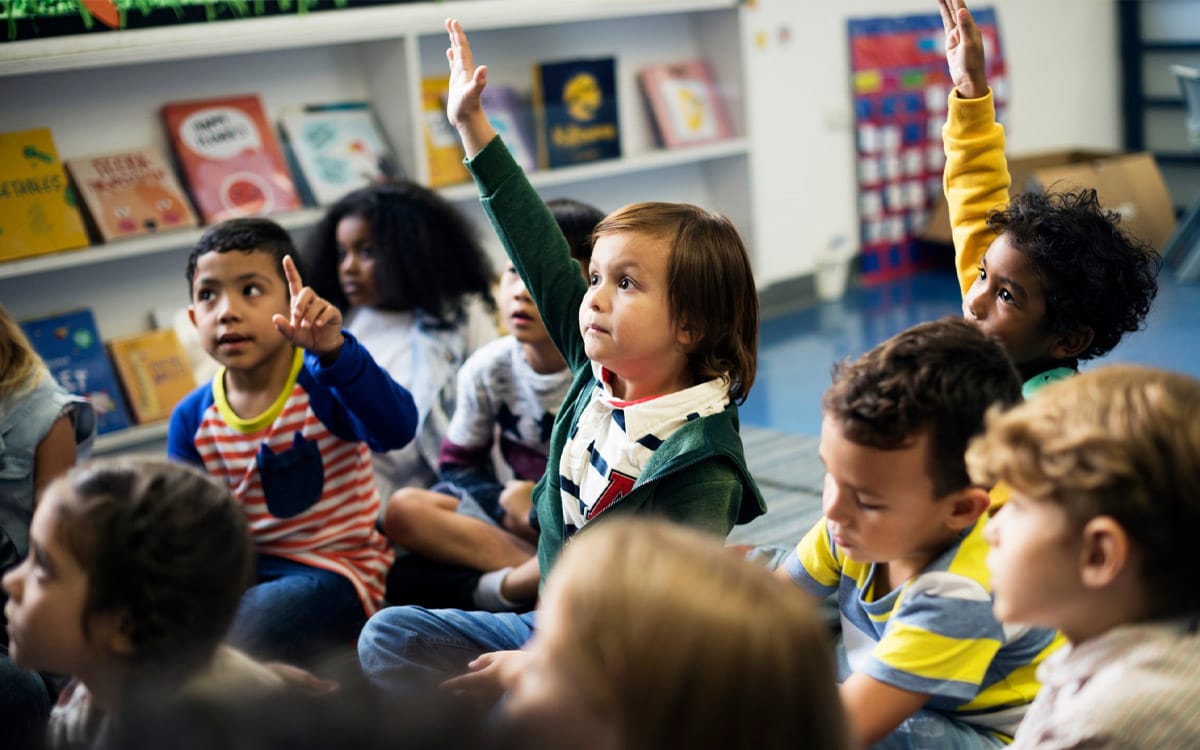
In our classrooms, we don’t translate back and forth for children. Instead, teachers stay consistently in one language during a given activity, so children learn to associate context with language naturally, the same way they would in a bilingual household. During circle time, snack, or outdoor play, the language stays constant and predictable. This consistency is what allows the brain-building “switching” to happen organically, rather than through memorized translation.
You can see how this plays out across a full day in our Preschool Program, and how it continues to build on itself in our Toddlers Program for younger children. It also carries into warmer months through our Summer Camps, which keep language exposure consistent year-round.
Why Early Childhood Is the Ideal Window
Young brains are especially well suited to absorbing more than one language. Before around age seven, children’s brains are highly efficient at picking up the sounds, rhythms, and grammar of a new language simply through exposure, without formal instruction.
This is part of why early bilingual education tends to produce more natural, confident speakers than starting a second language later in school. It isn’t that older children and adults can’t learn a language. It’s that young children absorb it as effortlessly as they absorb their first one. Our why families choose bilingual immersion page goes deeper into how we’ve built our program around exactly this window.
If you’re weighing timing for your own family, we’ve covered this in more detail in our guide to the best age to start French immersion.
How Parents Can Support Bilingual Development at Home
You don’t need to be bilingual yourself to support what your child is building at school. A few things matter far more than perfection:
- Read together often, in either language, even if it’s just a few minutes a day
- Narrate daily routines out loud, which gives children natural repeated exposure to vocabulary
- Limit passive screen time, since language development depends on real back-and-forth interaction, not one-directional input
- Celebrate attempts, not accuracy, so children stay confident experimenting with both languages
Why Consistency Matters More Than Perfection
One thing we tell every family during enrollment: you don’t have to get this right every day. Bilingual development isn’t built on perfect grammar or flawless pronunciation at home. It’s built on steady, low-pressure exposure over time.
Children aren’t learning two languages. They’re learning to think more flexibly. A consistent daily rhythm, at school and at home, does far more for long-term bilingual development than any single “correct” method. You can read more about the thinking behind this approach on our Our Philosophy page.
✓ Key Takeaways
- Bilingual children’s brains stay active in both languages at once, building stronger focus and flexibility
- Decades of research, from Bialystok’s executive function studies to Kuhl’s work on infant speech perception, support these findings
- Code-mixing is a normal developmental stage, not a sign of confusion or delay
- Early childhood is the most efficient window for absorbing a second language naturally
- Consistency at home and school matters more than getting every detail “right”
Parent Questions
Frequently Asked Questions
Clear answers to the questions families ask most often about bilingual development.
01 Does learning two languages delay speech development?
No. Research consistently shows bilingual children reach speech milestones on the same general timeline as monolingual children when total language exposure across both languages is considered.
02 Will my child mix up the two languages permanently?
No. Code-mixing is a normal developmental stage and typically decreases as vocabulary grows in both languages.
03 Is it too late to start bilingual education after age three?
Not at all. Earlier exposure can make language learning feel more natural, but many children begin bilingual education successfully between ages two and five.
04 Do the cognitive benefits of bilingualism last into adulthood?
Research suggests that bilingual adults may retain stronger attention control and cognitive flexibility throughout life.
05 Do I need to be bilingual for my child to benefit?
No. Consistent bilingual exposure at school, combined with a language-rich and supportive home environment, is what matters most.
06 How is bilingual immersion different from teaching vocabulary?
Vocabulary lessons teach individual words. Bilingual immersion gives children daily practice using two active language systems through conversation, routines, play, and meaningful interaction.
The Takeaway for Parents
A bilingual childhood isn’t just about learning a second language. It’s about building a brain that’s more flexible, more focused, and better equipped to handle complexity, skills that matter far beyond the classroom.
At KOALA-NC, this is the foundation of everything we do. Our bilingual French immersion program is designed around exactly this kind of natural, everyday language exposure, so children build these cognitive skills the way they’re meant to: through play, connection, and daily life, not drills. See full details on our Tuition & Fees page, or take the next step on our Waiting List page.
Further Reading
- Ellen Bialystok — bilingualism and executive function research
- Patricia Kuhl — infant speech perception, University of Washington
- Harvard Center on the Developing Child
- National Institutes of Health (NIH)
Give your child the lifelong advantages of bilingual learning. Join the KOALA-NC Waiting List
